Learning Across Boundaries: Designing IIOE AI + Cross-Border E-Commerce Micro-Certification Course
Prior to the course's finalisation, the IIOE underwent a process of research, deliberation, and iterative refinement. To ensure the course closely aligns with real-world needs, IIOE invited institutions with deep experience in cross-border e-commerce education, leading enterprises, industry associations, and government regulatory bodies to engage in collaborative discussions. As these discussions progressed, key consensus points emerged: the clarity of strategic policy intent from institutional leadership, the ability of teachers to bridge theory and practice flexibly, and the possession of practical operational and problem-solving skills by students were identified as crucial factors for the course's practical applicability.
Consequently, the course design further delineated and responded to the roles and needs of three core stakeholder groups in higher education, forming a complete cycle from macro-level understanding to micro-level practice:
Tier 1 is global perspective and top-level design (for leaders and managers). The objective is to cultivate decision-makers with a global outlook and systemic thinking. Content covers the global landscape of cross-border e-commerce, methodologies for designing university programmes, multi-platform operation strategies, and innovative practice cases from countries like China and Ethiopia. This helps managers grasp trends, understand models, and learn from experiences to scientifically plan their institution's cross-border e-commerce education and development path.
As mentioned, the international trade landscape is undergoing significant changes with the accelerated restructuring of global value chains. Against the backdrop of sluggish growth in traditional trade, digital trade, particularly cross-border e-commerce, is creating new spaces and emerging as a key growth driver. Its rise has altered consumer goods trade patterns, enabling Global South countries and SMEs to participate more directly in global trade.
The course Cross-Border E-Commerce Global Ponarama interprets the global market size, growth drivers, geopolitical analysis, key competitive factors, and policy and regulatory risks of cross-border e-commerce, helping managers build a foundational understanding. It makes them aware that cross-border e-commerce is not merely a commercial phenomenon but a complex field combining digital technology and international rules, requiring educational planning from the perspective of national development and regional economic needs.
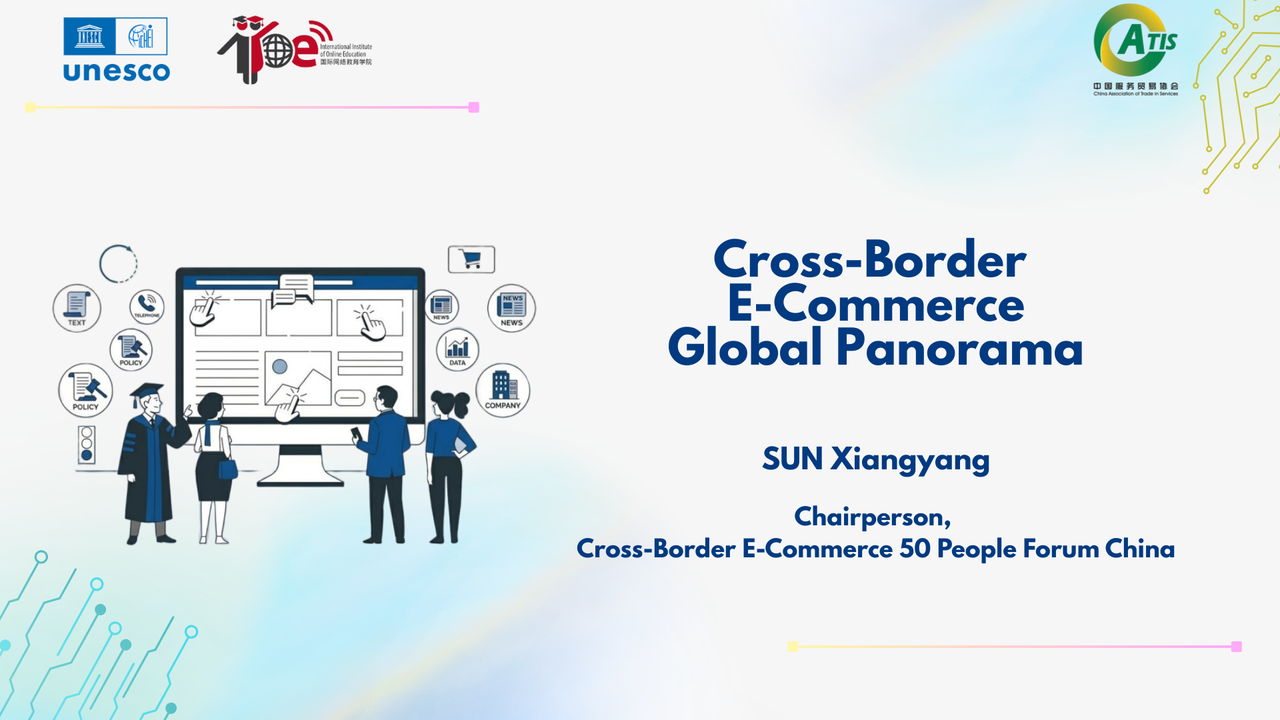
IIOE Cource: Cross-Border E-Commerce Global Panorama
Teaching in the Age of Platforms
Tier 2 is teaching capacity and professional depth (for teachers). The goal is to empower teachers to become "dual-qualified" talents with both theoretical knowledge and practical experience. Content focuses on core cross-border e-commerce operations, such as seller operations, compliance and risk management, new marketing strategies, payment and settlement, data analysis, and AI applications. The course not only imparts specialised knowledge but also enhances teachers' course delivery capabilities and practical guidance skills through platform hands-on practice (e.g., on platforms like E-Trade Cloud) and teacher development cases.
The course empowers the teaching workforce, developing "dual-qualified" teaching key personnel. It includes modules specifically designed for teachers, enhancing their expertise through "theory + platform practice + case studies"; provides teacher development cases and teaching guides to help them translate industry knowledge into teaching designs; and promotes the establishment of a collaborative teaching mechanism involving university teachers and enterprise mentors, building a sustainable ecosystem for teacher development.
Tier 3 is practical skills and process integration (for students and practitioners). The aim is to cultivate versatile technical talent with strong immediate operational capability, competent across the entire cross-border e-commerce workflow. The Global South faces pronounced digital divide issues, such as high concentration of cross-border e-commerce development in certain countries, poor infrastructure, outdated payment systems and regulatory challenges, and digital skills shortages. Notably, there is a shortage of versatile talent proficient in both international trade, supply chain, finance, tax, and compliance, as well as foreign languages, platform operations, digital marketing, etc.
The IIOE AI+Cross-Border E-Commerce Micro-Certification course content employs blended learning modules centred around the entire cross-border e-commerce business process (from market entry, product selection, supply chain and logistics, pricing and marketing, to customer service, compliance, and risk control). Each step is broken down into standardised learning units comprising 1 theoretical video, 1 practical operation video, and1 case study or tips sheet. This integrated Learn-Do-Reflect model ensures learners not only understand the "why", but also master the "how".
The course aims to promote educational equity and inclusive growth, expanding the reach of quality education
The entire Cross-Border E-Commerce Micro-Certification course forms an organic whole through its macro-strategic composition, achieving full-chain integration from conceptual guidance to teaching support and finally to skill application. It addresses the structural contradiction of education lagging behind industry, achieving deep industry-education integration. It transforms real business scenarios into teaching units, keeping classroom content aligned with market frontiers; provides universities with ready-to-use, high-quality teaching resources, significantly lowering the threshold and trial-and-error costs of course development; and empowers universities in their transition from knowledge transmitters to co-builders of industrial capability.
The micro-certification can serve as a supplement to degree programmes or be offered independently to in-service professionals and small business owners; its modular design facilitates localised adaptation based on specific national industry characteristics (e.g., agricultural exports, handicrafts), serving local economies; the online delivery model allows institutions in remote areas to access quality resources, narrowing the digital divide and enabling more youth, especially women and rural youth, to acquire knowledge for participating in global trade.
For universities across the Global South, the course represents an effort to explore new, more systematic ways of approaching change. It offers institutions a different perspective on curriculum development and talent cultivation in cross-border e-commerce, helping align teaching design and skills development more closely with the evolving practices of the digital economy. It also provides students with a structured approach to gradually build professional capabilities that can adapt to international contexts.
In an era where digital technologies are reshaping the global trade landscape, the IIOE stands ready to collaborate with its network, inviting HEIs worldwide to join hands in advancing the localised iteration, systematic refinement, and scaled implementation of curriculum series. This initiative aims to empower more economies and practitioners to seize opportunities in the digital economy and adapt to the demands of the AI era. We seek to foster inclusive and equitable development within the global digital economy, collectively advancing the construction of a digital civilisation.
-
SUN XiangyangAthorIIOE Cross-Border E-Commerce Micro-Certification Project Consultant; former Chairperson of Cross-Border E-Commerce 50 People Forum China.
- The Evolution of Agritechnology Education in Malaysia: Lifelong Learning Pathways, Government Support, Linkages to SDGs
- Learning Across Boundaries: Designing IIOE AI + Cross-Border E-Commerce Micro-Certification Course
- Insights from IIOE's Industry-Oriented Learning Initiatives
- When Trade Begins to Think: New Possibilities in Emerging Markets
- Growth is Here: Are Skills Ready?
- Digital Intelligence, Talent as the Bridge: Opening a More Inclusive Future for Global Digital Trade